
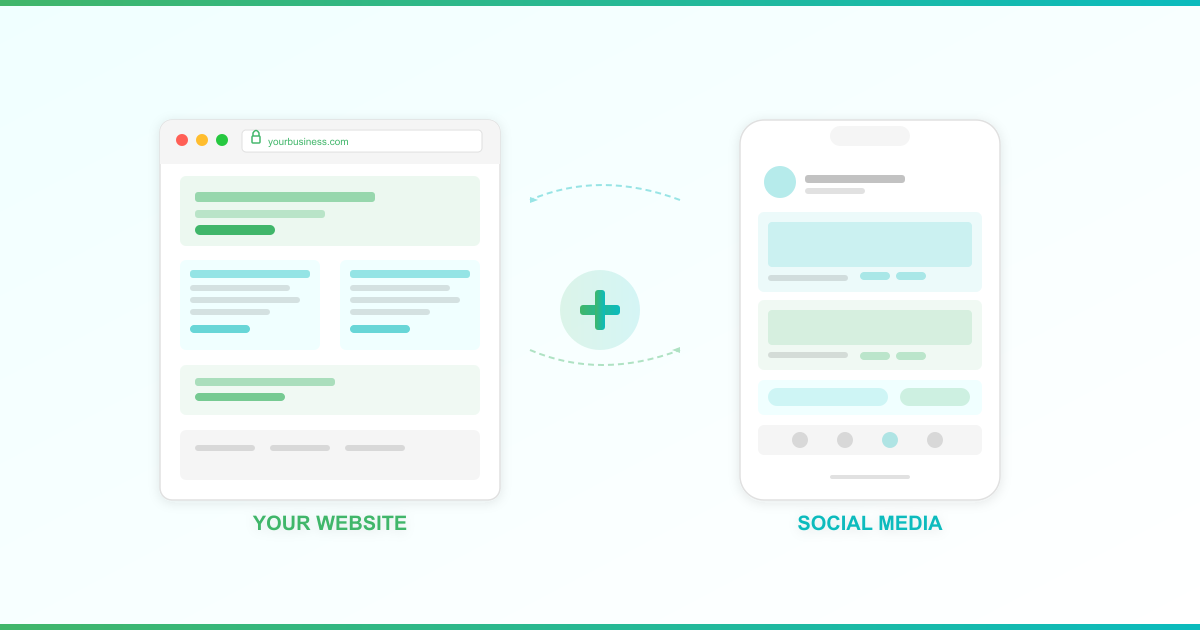

Website vs social media is one of the first decisions every Ghanaian business owner faces in 2026, and the answer shapes how customers find you, how much you pay to reach them, and what happens if a platform changes its rules. A website is a property you own at a domain you control, indexed by Google, where you decide who sees what and which customer data you keep. Social media is rented space inside someone else’s app, where an algorithm decides who sees your posts and the platform owns the customer relationship. That single difference, ownership and discoverability, is why your Facebook Page, WhatsApp Business profile, and Instagram account cannot replace a website, and why the strongest Ghanaian businesses run both. The comparison table below breaks down the six factors that decide which channels your business needs, then this guide shows you how to combine them.
Should Your Business Have a Website, Social Media, or Both?
Before the deeper comparison, here is the short answer in one scannable view. Six factors, three columns, no narrative.
| Factor | Website only | Social media only | Both together |
|---|---|---|---|
| Discoverability on Google | Strong — ranks for buyer-intent searches | Weak — profiles rarely rank for product searches | Strong — site ranks, social drives brand searches |
| Trust signals | Strong — own domain, SSL, professional email | Moderate — depends on follower count and reviews | Strongest — trust on both surfaces reinforces each other |
| Cost | Modest annual cost for domain plus hosting | Free to set up; paid reach is the real cost | Modest annual cost plus optional ad spend |
| Control | Full — you own the content, design, and data | Limited — platform rules can change anytime | Full on your site, limited on the platforms |
| Customer support reach | Forms, live chat, knowledge base on your terms | Fast DMs and WhatsApp replies in real time | Best — quick chat where customers are, deeper help on your site |
| SEO compounding | Strong — pages keep earning traffic for years | None — posts disappear within hours | Strong — the site compounds while social keeps you top of mind |
Most Ghana businesses need both. The website wins on long-term discoverability, trust, and control. Social media wins on day-one reach and real-time conversation. Run them together and each channel makes the other one stronger.
Website vs Social Media: The 4 Differences That Matter

No. They serve different functions, and the distinction matters more than most business owners realise. Here are the four differences that decide whether your business is built on solid ground or rented land.
1. Ownership vs Rented Space
When you register a domain and pay for hosting, that property belongs to you. The files, the design, the customer list, the order history, all of it is yours. A Facebook Page or Instagram account, by contrast, lives inside Meta’s platform under Meta’s terms. You are a tenant. The landlord can change the rules, raise the rent, or evict you with no warning.
2. Algorithm Control
On social media, an algorithm decides which of your followers actually see your post. You do not control it, you cannot audit it, and it changes constantly. On your website, every visitor who lands on a page sees exactly what you published. No filter sits between your content and your audience.
3. Discoverability on Google
When someone in Accra searches “catering services near me” or “affordable furniture in Kumasi,” Google shows websites, not Facebook Pages. Search is where buying intent lives. A website with proper SEO can rank for the queries your customers actually type, and that traffic compounds month after month. Social posts disappear from the feed within hours.
4. What Happens When the Platform Changes the Rules
Meta has banned, restricted, or shadow-limited countless business accounts across Africa with no appeal route. When that happens, years of customer relationships vanish overnight. If your hosting provider goes down, you switch hosts and your site comes back online with the same domain, the same content, and the same customers. The risk profile is fundamentally different.
Learn how to get your website on Google with our SEO starter guide for Ghana.
Website or Social Media Channel: A Quick Guide
A quick definitional check, because the lines do blur.
Social media is any platform built around a user feed, a social graph, and an algorithm that ranks content. Facebook, Instagram, TikTok, X, LinkedIn, YouTube, and WhatsApp all fit. Posts live inside the platform. The platform decides distribution.
A website is a collection of pages hosted on a server you pay for, served from a domain you own, and accessible at a permanent URL. Visitors arrive directly, from Google, from a link you shared, or by typing your address. There is no feed and no algorithm filtering your content.
Edge cases worth noting:
- A blog on your own domain is a website, even if readers can comment. You own the platform.
- A forum on your own domain is a website with social features, not social media.
- A Medium publication or a LinkedIn newsletter is closer to social media because the platform owns the audience and the algorithm decides reach.
- A WhatsApp Business catalog is a feature inside WhatsApp, not a website.
If you do not own the domain and the database, it is not your website.
Facebook Business Page vs Website: Which Wins?
Many Ghanaian businesses ask the question slightly differently: “Is my Facebook Page basically a website?” Short answer, no. They look similar from a customer’s perspective, but the underlying economics, control, and discoverability are very different. Here is the side-by-side.
| Dimension | Facebook Page | Your Own Website |
|---|---|---|
| Upfront cost | Free to create | Domain plus hosting at a modest annual cost |
| Ongoing control | Meta sets the rules and can change them anytime | You own the domain, content, and design |
| Discoverability on Google | Page profiles rarely rank for product or service searches | Pages can rank for any keyword you target with SEO |
| SEO compounding | Each post is short-lived in the feed | Articles and product pages keep earning traffic for years |
| Customer data ownership | Meta owns the relationship; you cannot export your follower list as contacts | You collect emails, phone numbers, and order history directly |
| Algorithm risk | Organic reach hovered between 1% and 2% in 2025, down from roughly 16% in 2012 | Visibility depends on Google ranking, which you can influence |
| Account-loss risk | Pages can be restricted or banned without warning | If your host goes down, you switch hosts and the site comes back |
| Direct selling | Marketplace and DM-based; no built-in checkout for most regions | WooCommerce, Shopify, or Paystack-style checkout you control |
The Facebook Page wins on speed of setup and proximity to existing audiences. The website wins on every dimension that compounds over time, search visibility, customer data, payment processing, and resilience.
Meta’s Algorithm Reach Decline and What It Means for Your Page
The single most important number behind that table is how many of your followers actually see your posts. Organic reach for Facebook Pages averaged between 1% and 2% in 2025, down from roughly 16% in 2012 (Hootsuite). At a 1.37% benchmark, a Page with 10,000 followers reaches roughly 137 people per organic post. A Page with 50,000 followers reaches around 685 people.
That is not a content problem. That is the platform reducing organic distribution to push businesses toward paid reach. A website hedges that risk. When your blog post ranks on Google, every person who searches for that topic sees your full page, no algorithm in between. The same logic applies to account restrictions: many Meta business accounts in Africa have been limited or banned with no clear appeal route. A website you own cannot be taken down by a platform policy change.
Treat your Facebook Page as a distribution channel, not as your storefront. Your website is the storefront.
Why a Website Beats Relying Only on Social Media
The four-point comparison above sets the foundation. Here is what those differences actually deliver to your business day to day.
You Own It
When you register a domain and set up hosting, that digital property belongs to you. Your content, your customer data, your product listings, all under your control.
Facebook Pages average organic reach hovered between 1% and 2% in 2025, down from roughly 16% in 2012 (Hootsuite). Even if you have built a serious following, the vast majority never see your posts unless you pay to boost them.
Your website has no such filter. Every visitor who types your URL or finds you on Google sees exactly what you want them to see.
Google Finds You
Search engine optimisation is one of the most powerful ways to attract customers who are actively looking for what you sell. Social media is great for discovery, but search engines are where intent lives. Someone searching Google already wants what you offer. Your job is to show up.
A well-structured website with relevant content ranks in Google and brings you steady, free traffic month after month. Your social media posts disappear from feeds within hours. A blog post on your website can bring visitors for years.
Credibility and Professionalism
Picture two businesses. One sends you a WhatsApp message from a personal number with a Gmail address. The other has a clean website at www.theirbusiness.com and emails you from info@theirbusiness.com.
Which one feels more established?
A professional domain and email address signal that you are serious about your business. Customers trust businesses with websites more than those operating only through social media. For B2B clients, corporate partnerships, and government contracts, a website is not optional, it is expected.
Your website also runs on SSL and HTTPS, which tells browsers and customers that your site is secure. That padlock icon builds trust before a visitor reads a single word.
You can set up professional business email alongside your website hosting. Every LUMINWEB hosting plan includes unlimited email accounts on your domain.
Ecommerce on Your Terms
Selling through Instagram DMs and WhatsApp works for small volumes. But as your business grows, you need a proper checkout system.
A website with WooCommerce or a similar ecommerce plugin gives you a full online store. Customers browse your products, add items to a cart, and pay, all without sending a single DM. You can accept mobile money through Paystack, process card payments, and offer bank transfers.
No marketplace fees. No platform commission. Your store, your rules.
Ready to sell online? Read our guide on ecommerce hosting in Ghana.
Your Website Works While You Sleep
A customer in London wants to order from your Ghanaian business at 2 AM Accra time. On social media, they send a DM and wait. On your website, they browse your products, read your FAQ, place an order, and pay, all while you sleep.
Your website is your hardest-working employee. It never clocks out, never takes a break, and handles unlimited customers simultaneously.
Ready to give your business a permanent home online? See LUMINWEB’s affordable hosting plans — built for Ghana businesses, with a free domain, free SSL, and one-click WordPress.
Why Social Media Still Matters
A website alone is not the complete picture either. Social media excels at things a website cannot easily replicate, and Ghana’s social-first audience makes the case especially strongly.
Discovery and Reach
Ghana had 8.59 million social media user identities in October 2025, equivalent to 24.4% of the population (DataReportal, Digital 2026 Ghana). Facebook alone reached 8.40 million users in Ghana over the same window, with Instagram at 2.30 million. That is where a meaningful share of your potential customers already are.
Social media lets you reach people who do not know your business exists yet. A shared post, a viral reel, a WhatsApp status update, these put your brand in front of new eyes without the audience needing to search for you.
Real-Time Engagement
Social media is a conversation. You can respond to questions instantly, share behind-the-scenes content, run polls, and build relationships that feel personal.
WhatsApp is by far the most-used messaging app in Ghana, and a WhatsApp Business profile with a product catalog, quick replies, and automated greetings meets your customers exactly where they communicate. For most informal commerce in Ghana, the first conversation still happens on WhatsApp.
Speed and Simplicity
Posting a new product photo takes seconds on Instagram. Sharing a promotion on your WhatsApp status costs nothing and reaches your contacts immediately. Social media has almost zero friction for content creation.
That speed is valuable. You can announce a flash sale, respond to a trending topic, or share a customer testimonial in real time.
Social Proof
Reviews, shares, comments, and testimonials spread organically on social media. When a satisfied customer tags your business in a post, their entire network sees it. That kind of word-of-mouth endorsement is more persuasive than any advertisement. When you are ready to drive paid and organic traffic to that site, see how to advertise your business online in Ghana.
How Ghana Businesses Combine Both Effectively
The real power comes when you stop thinking of this as website versus social media and start using them as a team. Ghana’s specific mix, 26.3 million internet users at 74.6% online penetration but only 24.4% on social platforms (DataReportal, Digital 2026 Ghana), means a massive group of buyers reaches you through search rather than through a feed. A website captures that audience. Social handles the rest.
Social Media Drives Traffic to Your Website
Every social media post, story, and WhatsApp status is an opportunity to send people to your website. Share a blog post link. Feature a product with a “shop now” link to your store. Run a Facebook ad that lands on a dedicated page on your website.
Social media is the megaphone. Your website is the storefront.
Your Website Converts Visitors into Customers
Social media attracts attention. Your website closes the deal. A proper product page with clear descriptions, pricing, and a checkout button converts browsers into buyers far more effectively than a DM conversation.
Think of it this way: social media generates interest, your website generates revenue.
Professional Email Builds Trust in Social Conversations
When you follow up with a potential client over email, info@yourbusiness.com carries more weight than yourbusiness@gmail.com. Your domain-based email ties your social media conversations to a professional brand identity.
Full Local Visibility
Set up Google Business Profile and link it to your website. When someone searches for your type of business locally, Google shows your business with your website link, phone number, reviews, and directions.
Combine that with active social media profiles, and you appear everywhere your customers look, Google search, Google Maps, Facebook, Instagram, and WhatsApp.
A Practical Example
Consider a bakery in Accra. On Instagram, they post photos of fresh pastries and cake designs. On WhatsApp Business, they take custom orders through their catalog. On their website, customers can browse the full menu, place orders for delivery, pay with mobile money, and read the blog for baking tips that rank on Google.
Each platform feeds the others. Instagram followers visit the website to place orders. Blog readers follow the bakery on Instagram for daily updates. WhatsApp handles quick questions and repeat orders. The website captures search traffic from people who have never heard of the bakery.
That is the power of using both.
How to Add a Website Without Breaking Your Budget
One of the biggest reasons Ghanaian businesses skip a website is the assumption that it is expensive. It does not have to be.
Here is what you actually need:
Domain name: Your business name .com (or .com.gh). This is your address on the internet.
Web hosting: The server that keeps your website online 24/7. LUMINWEB’s affordable hosting plans include a free domain, free SSL certificate, and unlimited email accounts.
WordPress: Free, open-source software that powers a large share of the world’s websites. Install it with one click on your hosting account.
A free theme: Thousands of professional WordPress themes are available at no cost. Your site looks polished without hiring a designer.
Want the full breakdown? Read our guide on how much a website costs in Ghana.
Compare that investment to what you have already spent building a social media audience on a platform you do not own. Your website is an asset that appreciates over time. Your social media following is a number on someone else’s platform.
Getting Started: Your Website Plus Social Media Action Plan
Ready to complement your social media with a professional website? Here is your five-step plan.
Step 1: Register Your Domain
Choose a domain that matches your business name. Keep it short, memorable, and easy to spell. Every LUMINWEB hosting plan includes a free domain and free renewal.
Step 2: Set Up WordPress
With LUMINWEB WordPress Hosting, WordPress is ready in minutes through the one-click installer. No coding required. Choose a professional theme that matches your brand and customise it with your logo, colours, and content.
Need help? Follow our guide to install WordPress in minutes.
Step 3: Create Your Key Pages
Start with four essential pages:
- Home — What you do and why customers should choose you
- About — Your story, your team, your mission
- Products or Services — What you sell, with clear descriptions
- Contact — Phone, email, WhatsApp link, location map
You do not need 50 pages. Four strong pages beat 20 weak ones.
Step 4: Link Everything Together
Add your social media icons to your website header or footer. Put your website URL in your Instagram bio, Facebook page, and WhatsApp Business profile. Every touchpoint should connect to every other touchpoint.
Step 5: Drive Social Traffic to Your Website
Start sharing your website content on social media. Every new blog post, product launch, or promotion gets a link back to your site. Over time, your website builds search engine authority and drives organic traffic that does not depend on any algorithm.
Learn how to build a business website in Ghana with our complete step-by-step guide.
Frequently Asked Questions
Is a website social media?
No. A website is a property you own at a domain you control, indexed by Google, with no algorithm deciding who sees your content. Social media is rented space inside a third-party platform such as Facebook, Instagram, or TikTok, where the platform owns the audience relationship and an algorithm decides distribution. The two complement each other but are not the same thing.
Is a website considered social media?
No. A website is not considered social media because it lacks the two defining features of a social platform: a content feed and an algorithm that ranks what users see. Your visitors arrive directly at the page you publish, in the order you arrange it, with no third-party platform deciding distribution. Websites and social media can overlap on engagement features such as comments or sharing buttons, but the underlying ownership and distribution models are different.
Is my Facebook page considered a website?
No. A Facebook Page is a profile inside Facebook’s platform, not a standalone website. You do not own the URL, you cannot fully customise the design, you cannot export your followers as contacts, and the page rarely ranks on Google for product or service searches. A website lives at your own domain and you control everything on it.
What is the difference between a Facebook Page and a website for business?
A Facebook Page is free to create and lives inside Meta’s platform, where organic reach averaged between 1% and 2% in 2025 (Hootsuite) and Meta sets the rules. A business website lives at a domain you own, ranks for Google searches that drive buying intent, supports proper checkout through WooCommerce or Paystack, and keeps your customer data in your own database. Use the Facebook Page for awareness and quick replies; use the website to convert, to rank, and to own the customer relationship long-term.
Can I use only social media for my business?
You can start that way, and many Ghanaian businesses do. But relying only on social media exposes you to algorithm changes, account suspensions, and limited search visibility. With Facebook organic reach hovering between 1% and 2% in 2025, even a large following sees only a small share of your posts. A website removes that bottleneck and gives you a permanent home that Google can find.
Why do I need a website if I have Instagram?
Instagram is excellent for visual discovery and engagement, but it cannot rank in Google search, process payments natively in most regions, host long-form content, or give you customer data you can keep. A website does all of that. Instagram brings new eyes to your brand. Your website converts those visitors into customers and keeps the relationship.
Your social media presence is valuable. Protect and amplify it with a website you own.
Get started with LUMINWEB — affordable hosting with a free domain, free SSL, and one-click WordPress setup. Your business deserves both.
