
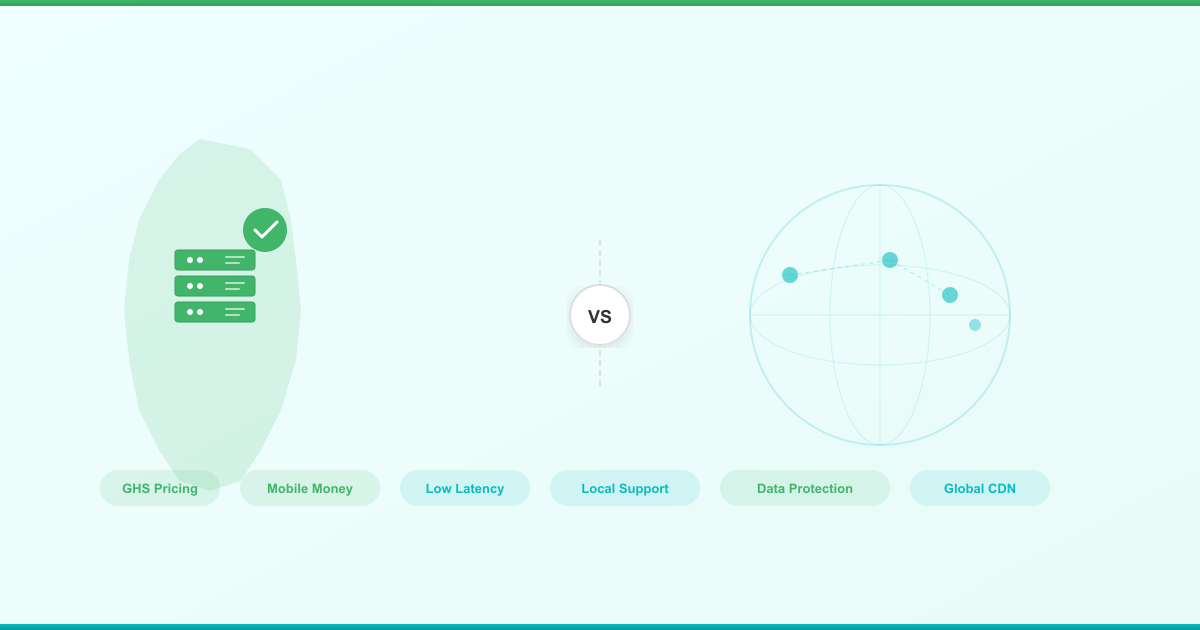



If you run a business in Ghana, choosing where to host your website is one of the most important decisions you will make online. The difference between hosting locally in Ghana and using an international provider like Hostinger, Bluehost, or GoDaddy comes down to six factors: speed for your visitors, pricing currency, payment options, customer support availability, data protection compliance, and how well the provider understands your market.
Ghana-based hosting gives you GHS pricing, mobile money payments, same-timezone support, and faster load times for local visitors. International hosting offers a wider product range and global CDN networks. The right choice depends on where your audience is and what your business needs.
This guide breaks down each factor honestly so you can make the best decision for your business.
What Is Ghana-Based Web Hosting?
Ghana-based hosting means your website is managed by a provider based in Ghana or one that optimizes its infrastructure specifically for the Ghanaian market. These providers price their plans in GHS, accept local payment methods like mobile money and bank transfers, and offer customer support during Ghana business hours.
The infrastructure backing these providers varies. Some use local servers, while others leverage global cloud platforms like Google Cloud to deliver fast, reliable performance. The key difference is that the business relationship — billing, support, and service — is local.
Examples include LUMINWEB, Webhosting.com.gh, and HostGhana.
What Is International Web Hosting?
International hosting providers operate globally from data centers spread across North America, Europe, and Asia. Companies like Hostinger, Bluehost, GoDaddy, and SiteGround serve millions of customers worldwide.
These providers typically price in USD or EUR, accept international credit cards, and offer 24/7 support via chat or ticket systems. Their infrastructure is designed for a global audience, with data centers strategically placed in major markets.
For Ghanaian businesses, the question is whether that global infrastructure translates into good performance for your specific audience.
Speed and Latency: How Server Location Affects Your Visitors
Server location directly impacts how fast your website loads for visitors. When someone in Accra visits your site, the data travels from the server to their device. The farther the server, the longer this takes.
A website hosted in Europe or North America can add 200-400 milliseconds of latency for visitors in Ghana and West Africa. A locally optimized hosting setup reduces this to 10-100 milliseconds. That difference matters more than you might think.
Research consistently shows that 53% of mobile users abandon a page that takes more than 3 seconds to load. For every additional second of delay, conversions can drop by up to 20%. In a market where most of your visitors access your site on mobile devices, every millisecond counts.
With over 74% of Ghana’s population now online and 41.8 million active mobile connections in the country, your visitors are overwhelmingly on mobile. Slow loading is not just an inconvenience — it directly costs you customers.
Where international hosts stand: Hostinger’s closest data centers to Ghana are in Europe (France, Germany, Netherlands, UK), with CDN presence in Johannesburg, South Africa. Bluehost’s primary data centers are in Utah, USA, with additional locations in London and Mumbai. Neither has infrastructure in West Africa.
The Google Cloud advantage: Providers like LUMINWEB that use Google Cloud infrastructure benefit from Google’s global network, including the Equiano subsea cable that connects directly to West Africa through Togo and Nigeria. This means enterprise-grade network routing without the typical latency penalty of international hosting.

Pricing: GHS vs USD and the Exchange Rate Factor
One of the biggest practical differences between local and international hosting is currency.
Ghana-based hosts price in GHS. You know exactly what you are paying each month or year. There are no surprises when the exchange rate shifts.
International hosts price in USD or EUR. When the Ghanaian cedi weakens against the dollar — which has happened significantly in recent years — your hosting bill goes up even if the provider does not change their prices. A plan that costs $5/month might seem affordable, but the actual GHS amount fluctuates constantly.
This is not just about the hosting fee itself. International providers often charge in USD for add-ons, domain renewals, and premium features. Those costs compound when exchange rates move against you.
Local providers also tend to include more in their base plans. For example, LUMINWEB includes a free domain and renewal, free SSL certificates, and Imunify360 security on every plan. Many international hosts charge extra for domain renewal, SSL on certain tiers, or advanced security features.
Payment Methods: Mobile Money vs International Cards
Payment flexibility is a practical concern that gets overlooked in most hosting comparisons.
Ghana-based hosts accept:
- Mobile money (MTN MoMo, Vodafone Cash, AirtelTigo Money)
- Bank transfers in GHS
- Debit and credit cards
International hosts typically require:
- International credit or debit cards (Visa, Mastercard)
- PayPal (which has limitations for Ghanaian accounts)
MTN MoMo is the dominant mobile money platform in Ghana, and for many small business owners, it is the most convenient way to make payments. If your hosting provider does not accept mobile money, you need to maintain an international card — which comes with its own fees and complications.
This is not a small issue. For a sole proprietor running an Accra-based fashion brand or a restaurant owner setting up their first website, the ability to pay with mobile money removes a real barrier.
Customer Support: Time Zones and Language
When your website goes down at 2 PM on a Tuesday in Accra, you want to reach someone who is available right now, speaks your language, and understands your context.
Ghana-based hosts operate in your timezone (GMT/UTC+0). Support teams understand local internet challenges, power fluctuations, and the business landscape. You can call a local phone number or reach someone during your working hours.
International hosts offer 24/7 support, which sounds better on paper. In practice, you are often working with support agents who do not understand the specific challenges of running a website in Ghana. Response times via chat are usually fast, but resolving complex issues may require multiple interactions across time zones.
Being honest: Large international providers like Hostinger and SiteGround have invested heavily in their support systems. Their 24/7 availability is genuinely useful if you have a late-night emergency. The trade-off is personalization and local context.
Data Protection and Privacy Regulations
Ghana’s data protection landscape is evolving. The Data Protection Bill 2025 introduces stricter requirements for how personal data is collected, stored, and transferred across borders. Organizations must make reasonable efforts to localize personal data, and transfers outside Ghana require explicit consent or prior authorization.
If your website collects customer information — contact forms, e-commerce transactions, account registrations — where that data is stored matters.
With a Ghana-based host, your data stays within a regulatory framework you can control. With an international host, your customer data may be stored in the US, Europe, or Asia, potentially triggering cross-border data transfer requirements under the new bill.
This is especially relevant for businesses in regulated industries like finance, healthcare, and government services, where sector-specific data localization rules already apply.
For most small businesses, this is not yet a dealbreaker. But the regulatory direction is clear: Ghana is moving toward stronger data sovereignty protections. Choosing a local host now future-proofs your compliance.
Where International Hosts Have the Edge
A fair comparison acknowledges where international providers genuinely excel.
Wider product range: Providers like Hostinger and Bluehost offer everything from basic shared hosting to cloud hosting, VPS, dedicated servers, and website builders — all under one roof. Their scale lets them offer specialized products for nearly every use case.
Global CDN networks: International hosts often include built-in CDN (Content Delivery Network) with plans or as affordable add-ons. If your audience is spread across multiple continents, a global CDN caches your content closer to visitors everywhere.
Extensive documentation and tutorials: Years of serving millions of customers means international hosts have vast knowledge bases, video tutorials, and community forums. If you prefer self-service troubleshooting, this library of resources is valuable.
Competitive introductory pricing: International hosts frequently offer aggressive first-term discounts. You might find shared hosting for as low as $2-3/month for the first year. Just be aware that renewal prices are typically 2-4 times higher.
The Best of Both Worlds: Google Cloud Infrastructure with Local Support
The traditional trade-off was clear: choose local for convenience or international for performance. That trade-off is disappearing.
Providers like LUMINWEB run on Google Cloud infrastructure — the same platform that powers Google Search, YouTube, and Gmail. This gives you enterprise-grade network routing, SSD storage, and 99.9% uptime without sacrificing local advantages.
What this means in practice:
- Speed: Google’s global network, including the Equiano subsea cable serving West Africa, delivers fast routing to your visitors
- Reliability: Google Cloud’s infrastructure is built for scale, with redundancy that smaller local providers cannot match on their own
- Local billing: Plans priced in GHS with mobile money payment support
- Local support: Ghana-based team available during your business hours, reachable at a local phone number
- Security built in: Imunify360 firewall and malware scanning, free SSL certificates, and regular backups on every plan
- Control panel choice: Both cPanel and DirectAdmin available — pick the one you prefer
You do not have to choose between performance and convenience. You can have both.
How to Decide: Quick Comparison

| Factor | Ghana-Based Hosting | International Hosting |
|---|---|---|
| Pricing currency | GHS (stable, predictable) | USD/EUR (exchange rate risk) |
| Payment methods | Mobile money, bank transfer, cards | International cards, PayPal |
| Speed for Ghana visitors | Fast (low latency) | Slower (200-400ms added latency) |
| Customer support | Local timezone, local context | 24/7 but less local knowledge |
| Data protection | Easier compliance with Ghana laws | Cross-border transfer considerations |
| Product range | Core hosting products | Wider selection of specialized products |
| CDN / Global reach | Varies by provider | Strong global CDN networks |
| Documentation | Growing | Extensive libraries |
Choose Ghana-based hosting if:
- Your primary audience is in Ghana or West Africa
- You want pricing in GHS without exchange rate surprises
- Mobile money payment is important to you
- You value same-timezone support with local context
- Data protection compliance is a priority
Consider international hosting if:
- Your audience is primarily outside Africa
- You need highly specialized hosting products
- You prioritize extensive self-service documentation
- You have an international card and are comfortable with USD billing
For a deeper dive into what to look for in any hosting provider, read our complete guide to choosing reliable web hosting in Ghana.
Frequently Asked Questions
Is local hosting in Ghana faster than international hosting?
For visitors in Ghana and West Africa, yes. Locally optimized hosting delivers 10-100ms latency compared to 200-400ms for servers in Europe or North America. This difference directly impacts page load times and visitor experience, especially on mobile devices.
Can I pay for web hosting with mobile money in Ghana?
Ghana-based hosts like LUMINWEB accept mobile money payments including MTN MoMo, Vodafone Cash, and AirtelTigo Money. Most international hosting providers only accept international credit cards or PayPal.
Do I need to host my website in Ghana for data protection compliance?
Ghana’s Data Protection Bill 2025 introduces stricter rules for cross-border data transfers. While not mandatory for all businesses yet, hosting locally simplifies compliance, especially for regulated industries like finance and healthcare. The regulatory direction favors data localization.
Ready to Host Your Website in Ghana?
If your customers are in Ghana, your hosting should work for Ghana. That means GHS pricing, mobile money payments, fast load times, local support, and infrastructure you can rely on.
LUMINWEB gives you all of that, powered by Google Cloud. Every plan includes a free domain, free SSL, Imunify360 security, and a 30-day money-back guarantee.
Explore LUMINWEB’s hosting plans or get in touch to find the right plan for your business.
Related Articles
- What Is Web Hosting? A Beginner’s Guide
- Types of Web Hosting: Shared vs Dedicated Compared
- Free vs Paid Web Hosting: The Real Cost to Your Business
- VPS Hosting Explained: When Your Business Needs to Upgrade
- Web Hosting Security: Protect Your Website in Africa
- How to Migrate Your Website to a New Host
